
Leak detection system for district cooling networks in demanding climates
District cooling networks distribute chilled water across kilometres of buried pre-insulated piping in a wide range of climates. In particularly demanding environments, such as the Gulf region, even a single undetected leak can waste millions of litres of water, damage insulation, and compromise the entire network before the first cooling tower sensor registers an anomaly. In hot and water-scarce regions, where every litre of potable water has a real cost and summer temperatures can exceed 50°C, the economics of continuous leak detection are straightforward: detect early, pinpoint fast, restore service before the leak becomes an excavation project.
CWA System AB designs and manufactures leak detection systems used in district cooling networks across the world including India, UAE, Saudi Arabia and Qatar. The CWA 9000 series monitors up to 8 000 metres of pipe per alarm unit, pinpoints the location of a leak within ±1 % of the measured distance to the leak, and integrates directly with existing Building Management Systems via Modbus TCP/IP over LAN.
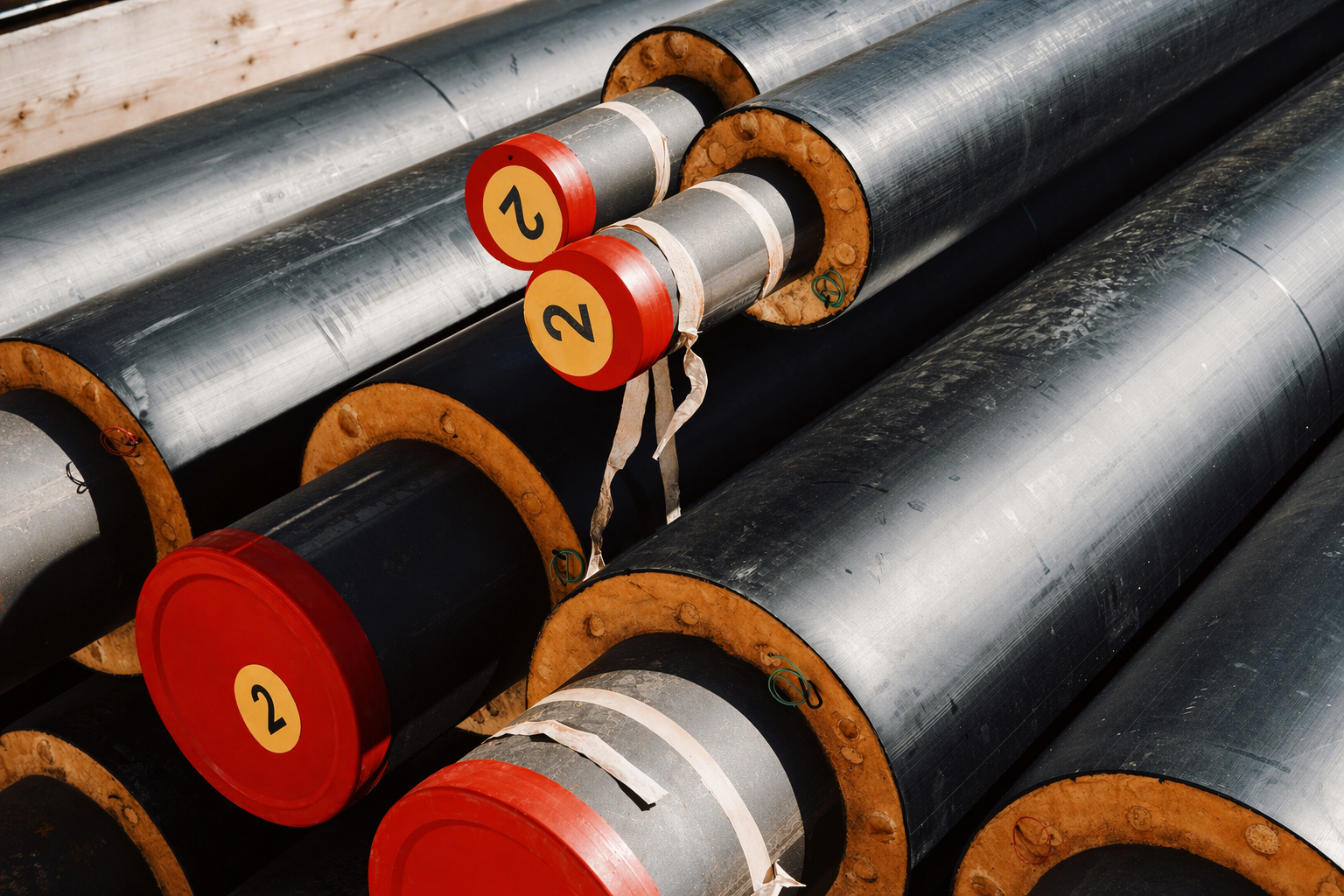
How the CWA system detects chilled water leaks
CWA uses Time Domain Reflectometry (TDR) on a pair of sensor wires embedded in the polyurethane insulation between the carrier pipe and the outer jacket. When water contacts the wires — whether from a leak in the carrier pipe or from ingress through a damaged jacket — the electrical impedance of the wire changes at the wet point. The alarm unit sends a calibrated electrical pulse along the wire, measures the reflection, and reports the exact distance to the fault.
Because chilled water has a stable and well-characterised dielectric constant, the system performs reliably across the operating temperatures typical of district cooling (approximately 4–12 °C supply, 14–16 °C return).
Unlike acoustic or flow-balance methods, TDR does not rely on pressure differentials or background noise — it works equally well in static pipes, low-flow conditions, and commissioning before first fill.
Location accuracy, not just alarm. Many leak detection options for pre-insulated pipes can tell you *that* a leak exists. CWA tells you where — within ±1 % of the distance to the alarm unit. On a typical 2 km loop, that is a location window of roughly 20 m, enabling targeted excavation rather than network-wide inspection.
Scalability for large networks. Each alarm unit monitors up to 8 000 m of sensor wire across four channels. Networks beyond a single unit chain multiple alarm units together, centralised to a single host computer. The same hardware platform serves a community development and a city-scale district cooling operator.
BMS-ready integration. The CWA 9213, 9223, 9233 and CWA 9243 models include an integrated LAN interface with Modbus TCP/IP. Alarms, fault locations and system status propagate directly to existing BMS, SCADA and control room infrastructure without custom middleware.
Designed for continuous duty. The alarm unit is rated IP 65, operates on 90–264 VAC, consumes 11 W, and logs fault events to non-volatile memory that survives power interruptions. CE-certified, manufactured in Sweden.
Why district cooling operators choose CWA
CWA systems have operated in GCC district cooling networks for over a decade. Installations contend with:
Desert ambient temperatures exceeding 50 °C — the alarm unit is rated for 0 to +40 °C as standard with an optional heater available for colder climates; standard enclosures cope with Gulf summers when installed in ventilated cabinets.
High-humidity coastal regions such as the Gulf coast — sealed connections and corrosion-resistant materials as standard.
Salt air exposure on pipelines running near sea water cooling infrastructure.
Sand and dust ingress — handled by IP 65 enclosure rating.
The sensor wire itself is installed during pipe manufacture by our pre-insulated pipe partners in the region, embedded in the polyurethane foam between carrier and jacket. This means quality is controlled at the factory, not at the trench.
Performance in Gulf and coastal climates
A typical 10 km district cooling loop uses:
2–3 CWA 9243 alarm units (four-channel gateway models) distributed along the loop
Integrated sensor wire pairs installed during pre-insulated pipe manufacture
LAN connection to the central BMS via Modbus TCP/IP
Host computer software (CWAPlot) for centralised monitoring and historic fault logging
Installation and commissioning are coordinated with the pre-insulated pipe manufacturer. CWA works with established partners across the GCC region — including pre-insulated pipe manufacturers in the UAE and Saudi Arabia — and with installation contractors in India who have integrated CWA monitoring into complete district cooling networks under their pipeline responsibility. System commissioning typically takes one working day per alarm unit, including calibration and BMS integration testing.
Typical district cooling installation
For design consultants and MEP specifiers, CWA provides:
Technical specification sheets, BIM-relevant dimensions and CE declarations
Reference lists (region-filtered; some installations confidential under client NDA)
Pre-contract technical dialogue with CWA engineers directly, not through a distributor
Integration guidance for BMS and SCADA systems
Training support for commissioning and operations teams
Supporting specifiers and operators
Can CWA be retrofitted to an existing district cooling network?
Retrofit is possible where the original pre-insulated pipe was installed with sensor wire provision between the carrier and jacket. Where sensor wire was not pre-installed, retrofit is limited to new pipe extensions or replacement sections — the sensor wire cannot be added to finished pipe from outside.
Does CWA work on chilled water specifically, or only on hot water systems?
Both. CWA's TDR technology detects water by impedance change on the sensor wire — it does not depend on fluid temperature. The same alarm unit is used in chilled water (district cooling), hot water (district heating) and industrial process pipelines. The practical upper temperature is set by the sensor wire insulation: standard plastic or silicone-insulated sensor wire covers all district cooling and district heating applications.
How is CWA different from acoustic leak detection?
Acoustic methods listen for the sound of a pressurised leak, which requires quiet operating conditions, trained operators and periodic surveys. CWA is a permanent, continuous system: a sensor wire embedded in the pipe insulation is monitored 24/7 by the alarm unit, which both raises an alarm and reports the leak location to within ±1 % of the measured distance to the leak. Acoustic methods typically cannot locate a leak with that precision, and cannot detect ingress through a damaged outer jacket before the carrier pipe fails.
How does CWA integrate with our existing BMS or SCADA?
The CWA 9213, 9223, 9233 and CWA 9243 models expose alarms, fault status and measured fault distance over Modbus TCP/IP via LAN. No custom middleware is required for integration with standard BMS and SCADA platforms — the same hardware connects to both small control rooms and city-scale utility monitoring systems.
What is the expected service life of the sensor wire?
The sensor wire is a passive, sealed element embedded in the polyurethane insulation at pipe manufacture. Its expected service life matches the pre-insulated pipe itself — typically 30+ years under normal district cooling operating conditions, with no field maintenance required on the wire itself. The alarm unit is the only active component and is designed for continuous operation with non-volatile fault logging.
Can CWA monitor a network that uses pipe from multiple manufacturers?
Yes. The sensor wire specification is a standardised twin-wire installed according to CWA's installation guide. CWA works with pre-insulated pipe manufacturers globally to ensure sensor wire compliance. Mixed-manufacturer networks are common on large district cooling expansions and are supported by the same alarm unit platform.
Frequently asked questions
We welcome technical enquiries from district cooling operators, MEP design consultants and pre-insulated pipe manufacturers.
Request a technical specification sheet or BIM data — email mail@cwa.se
Reference case enquiries — please include your project context
Distributor partnerships — we maintain relationships with established pre-insulated pipe manufacturers across the region